
Technical Deep Dive | Building a 3GPP R17-Compliant 5G NTN Verification Platform Based on OAI and LUOWAVE RFSoC SDR
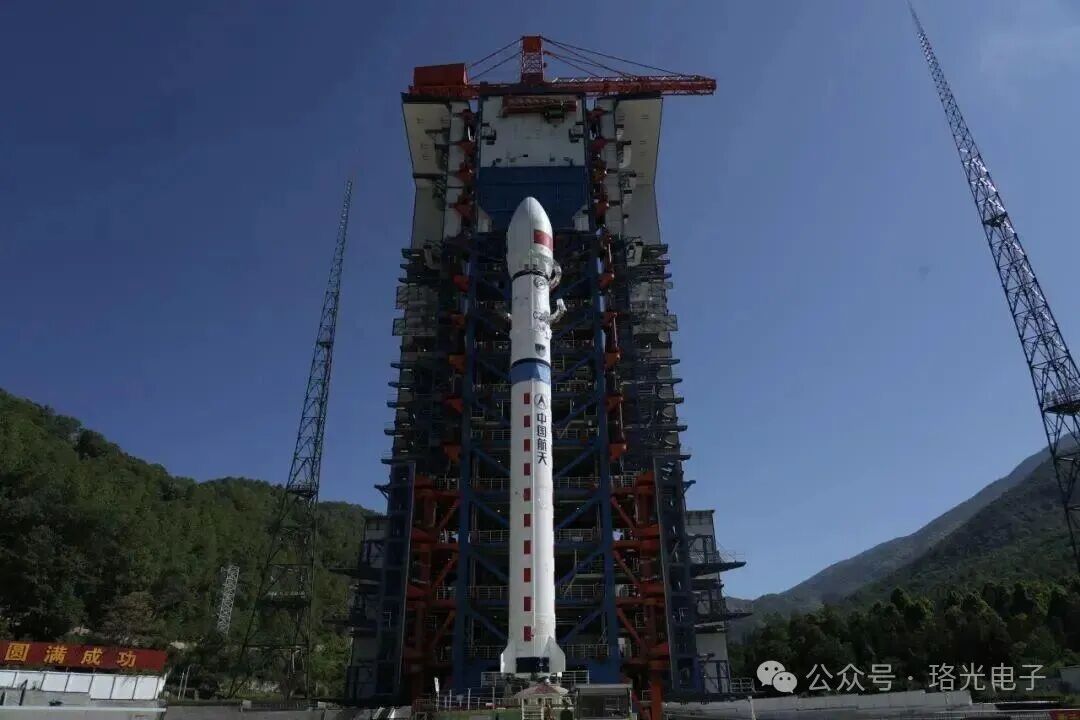
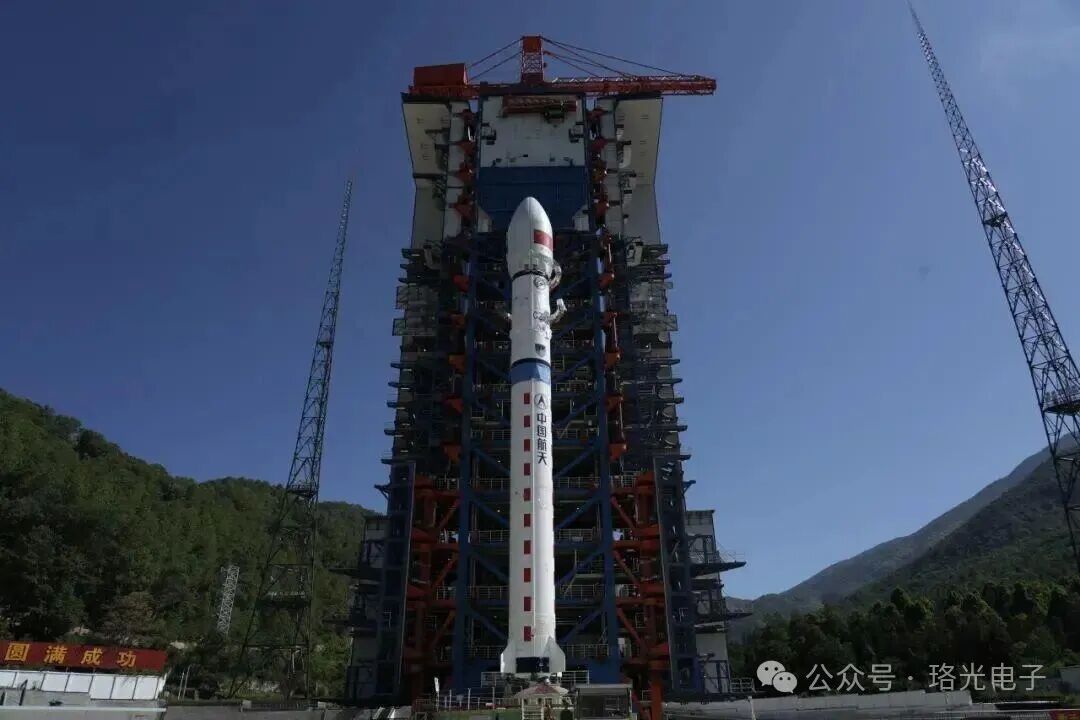
Recently, China has successfully launched multiple test satellites to support 5G NTN technical verification. On May 31, a satellite internet technology test satellite was successfully launched using a Long March 2D carrier rocket from the Xichang Satellite Launch Center, primarily to conduct technical baseline assessments for direct-to-cell and space-ground integration. On June 9, the Yuanxin Qianfan DTC01 satellite and the China Mobile 02 satellite were launched to conduct engineering tests, including NTN protocols and satellite-ground synchronization. The coordinated operation of space and ground platforms validates the 3GPP R17 Non-Terrestrial Network standard.
In the critical phase of engineering implementation for integrated space-ground communication, LUOWAVE has officially released a 5G NTN (Non-Terrestrial Network) full-stack technical solution based on the OpenAirInterface (OAI) protocol stack and the SDR-LW 4940 Note high-performance hardware platform. Strictly adhering to the 3GPP R17 standard, this solution addresses the high-mobility and long-latency challenges in Low Earth Orbit (LEO) satellite scenarios, providing a closed-loop ground prototype system spanning from algorithm verification to protocol layer adaptation.
Core Foundation: Why Choose This Architecture?
This solution aims to resolve the "misalignment" between actual satellite channels and ground equipment protocols. Through deep customization, we have constructed a four-layer, full-stack verification system:
Hardware RF Layer: Utilizes two LUOWAVE SDR-LW 4940 Note units, fully covering the 5G FR1 frequency band. The platform features an RFSoC architecture, significantly reducing system-level latency jitter. Its exceptional synchronization capability (standard 10MHz/1PPS) allows seamless interfacing with external channel emulators to accurately replicate real space-ground environments. Dual-unit joint testing supports external unified clock sources for synchronization.
Software Protocol Layer: Based on the latest OAI develop branch, it natively supports 3GPP R17 NTN features. The 4940 Note integrates high-performance computing units to support localized deployment of the OAI protocol stack, achieving integrated, high-efficiency operation and processing.
Channel Emulation Layer: Provides three modalities—"pure software, direct OTA, and full hardware emulation"—covering the entire R&D lifecycle from algorithm debugging to pre-field verification.
Core Network Layer: Supports Docker containerized deployment, ensuring that the signaling and user planes fully comply with 3GPP international specifications.
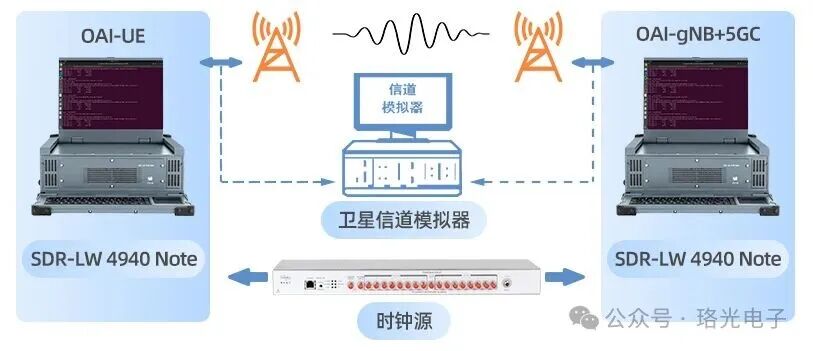
System Architecture
Technical Breakthroughs: Solving Three Major Challenges in NTN Communication
Targeting the large Doppler shifts and dynamic long latencies caused by the high-speed movement of LEO satellites, this solution deep-customizes the OAI develop branch to achieve the following key engineering breakthroughs:
1. Protocol-Level R17 Feature Alignment
The system fully incorporates the SIB-19 broadcast message processing logic, delivering key parameters through the ntn_Config_r17 structure.
Common Timing Offset: Utilizes ta-Common_r17 to achieve baseline compensation for the space-ground round-trip time (RTT).
Scheduling Timing Correction: Supports the cellSpecificKoffset_r17mechanism, utilizing slot-level scheduling offset processing to ensure that the uplink and downlink timing on both the terminal and base station sides are strictly aligned under long-latency links.
2. Slot-Level Uplink Timing Postponement
Since the LEO satellite RTT far exceeds the Cyclic Prefix (CP) protection range of terrestrial 5G, this solution implements a slot-level timing postponement scheme at the base station side.
Layered Delay Decomposition: Decomposes the massive satellite-induced RTT into integer slot offsets and fractional residual delays, adapting to the NTN timing compensation logic.
Adaptive Reception Postponement: Adjusts the uplink scheduling timing at the base station's MAC layer, postponing the delivery of reception commands to the physical layer. This matches the ultra-long satellite RTT and opens the reception window precisely when the terminal signal actually arrives, resolving the issue where the base station fails to recognize the random access preamble (Msg1) under long-latency scenarios.
3. Flexible Dual-Mode Switching
The solution supports flexible switching between two operating modes, allowing a single hardware set to accommodate both terrestrial and satellite communication testing scenarios.
Simple Operation: Quick switching between standard 5G Terrestrial SA mode and 5G NTN Satellite mode is achieved solely by modifying configuration files.
High Equipment Reuse: Minimizes the need for additional hardware purchases, effectively reducing R&D and deployment costs.
Visualization Capability: Enabling Full-Link Traceability for Protocol Interaction
For scientific research and pre-research, data observability is core. This solution provides robust visualization and debugging capabilities:
Protocol-Level Log Tracing: Supports log capturing across all layers—PHY, MAC, RLC, and RRC—rendering the origin and progression of every signaling message fully visible.
Deep Wireshark Analysis: Automated packet capture and analysis for protocols such as NGAP, NAS, and GTP-U enable researchers to verify the random access and PDU session establishment processes frame by frame.
Real-Time KPI Monitoring: Beyond protocol inspection, it quantifies performance gains from algorithm improvements through real-time monitoring of KPIs like Block Error Rate (BLER), throughput, and spectral efficiency.
A Powerful Tool for Moving from Theory to Implementation
Currently, satellite internet construction is in a critical acceleration phase. LUOWAVE provides more than just hardware; it delivers a mature, closed-loop technical solution. Utilizing the high flexibility of SDR, we translate complex, cutting-edge access algorithm theories into executable engineering code.
For research institutions and corporate R&D teams, this verification platform significantly lowers the barriers and costs of field testing. It establishes a solid technical foundation for standard verification and algorithmic breakthroughs in 5G NTN and future 6G space-ground integrated networks.