
Liquid‑Metal Fabric Antenna: 4.5m HD Video Link Proves Deformation‑Immune mmWave Wearables
When Clothing Becomes Antenna – This Research Is Reshaping the Future of Communications
Imagine: the shirt you’re wearing is itself a high‑performance millimeter‑wave communication device. You bend, run, fold it repeatedly – and the signal remains rock‑stable. This is not science fiction. It is the latest result from Professor Lu Weibing’s team (Southeast University’s Flexible RF Technology Research Center and Donghua University’s School of Information Science and Intelligence), just published in Advanced Science: Printable Liquid Metal‑Textiles for Deformation‑Insensitive and Electromagnetically Robust mmWave Devices.
In the wireless communication validation experiments of this study, Luoguang ’ self‑developed LW‑N310 served as the core test platform, undertaking the full‑link verification from signal generation to image reception, enabling the “wearable mmWave antenna” to achieve stable 4.5‑meter high‑definition image transmission.
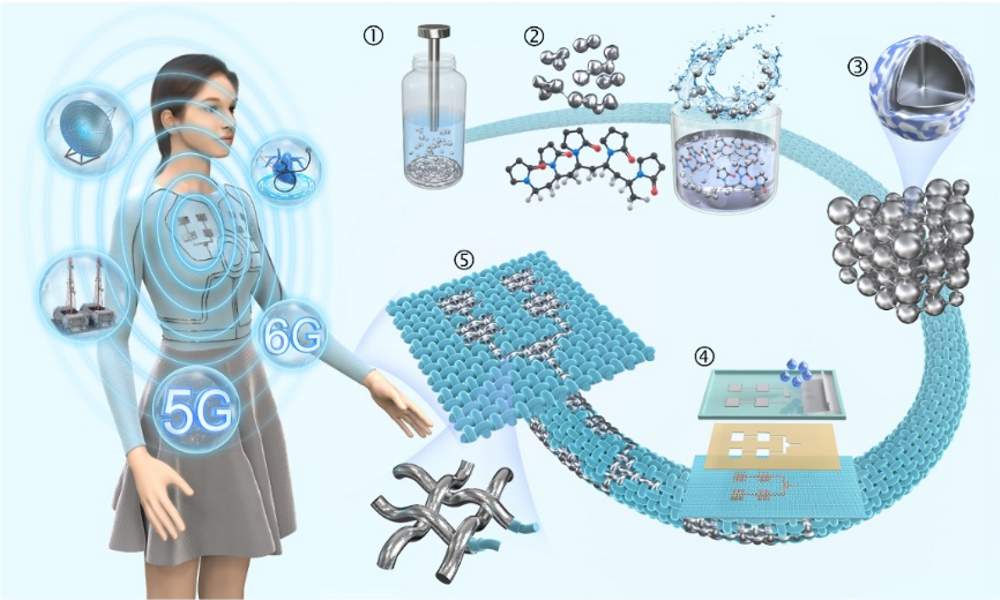
Figure 1 – Mechanically durable and electromagnetically robust high‑performance textile mmWave antenna
Research Background
With the rapid development of 6G and IoT, mmWave technology has become key to building next‑generation body area networks. However, mmWave devices are extremely sensitive to conductive path stability; conventional metal materials tend to crack under bending, stretching, and other deformations, causing signal distortion or even failure. How to maintain electromagnetic robustness under repeated deformation is a core challenge in flexible wearable RF technology.
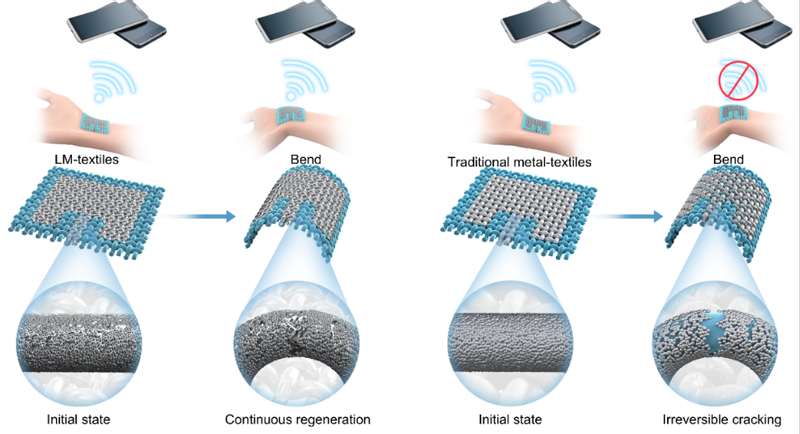
Figure 2 – Comparison of conductive networks under bending between liquid metal textile and conventional conductive textile: the former continuously self‑heals, while the latter suffers irreversible cracking
Core Innovation
The team proposed a functionalized liquid‑metal printable ink highly compatible with textiles. Combining nano‑effects and surface modification, it builds continuous and stable conductive paths within the 3D textile network. Thanks to self‑healing properties, it maintains a uniform sheet resistance of approximately 11.16 mΩ/sq even after repeated deformation. In addition, a high‑resolution “dual‑mask” printing process was developed, merging the high throughput of stencil printing with the precision of screen printing, enabling scalable fabrication of high‑reliability mmWave RF devices on textiles.
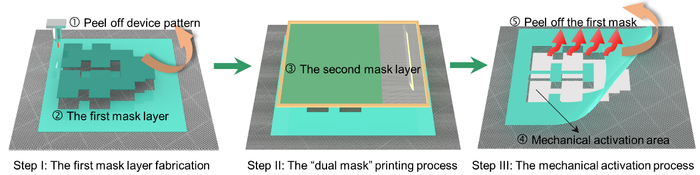
Figure 3 – Dual‑mask printing process
Based on this, the team fabricated a 26 GHz liquid‑metal textile antenna array, which maintained a stable gain of 9.65 dBi after multiple bending cycles.
LW‑N310: From Lab to Real‑World Validation
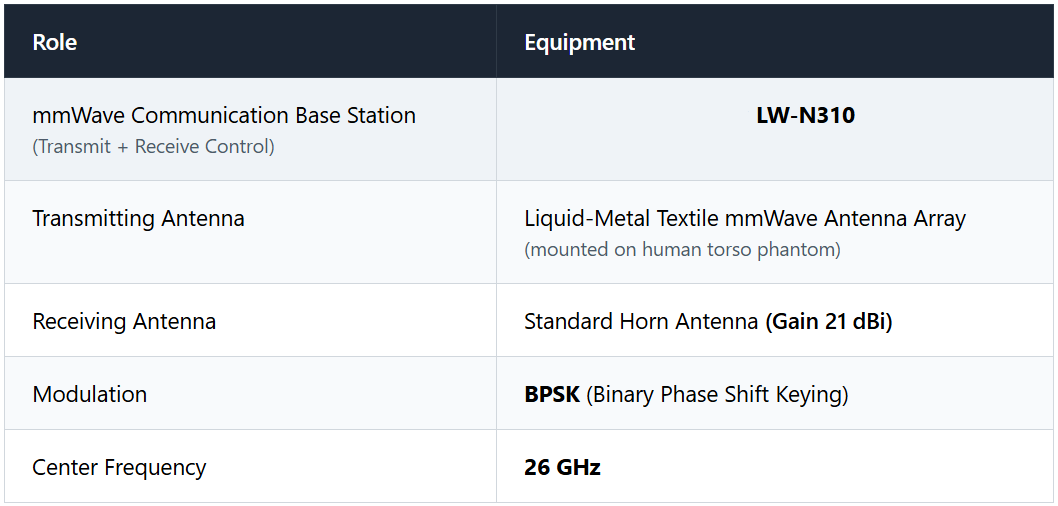
To verify the actual communication capability of the liquid‑metal textile antenna, the research team built a complete mmWave wireless communication test system, with Luoguang LW‑N310 as the central hub.
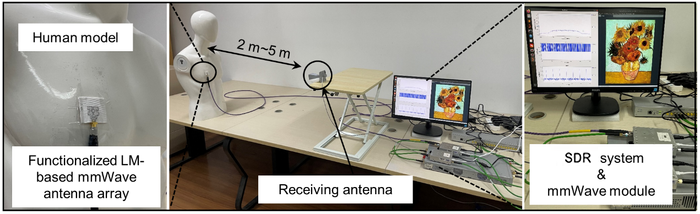
Figure 4 – System configuration for wireless communication testing of the liquid‑metal mmWave textile antenna
Testbed Configuration
Experimental Results
Initial state: The liquid‑metal textile antenna array achieved a maximum gain of 10.67 dBi and stable HD image transmission over 5 meters.
After mechanical deformation: Gain maintained at 9.65 dBi, still enabling 4.5‑meter HD wireless transmission.
Reference comparison: Commercial silver‑ink printed antenna suffered a significant gain drop to 5.48 dBi after deformation, with severely degraded communication range.
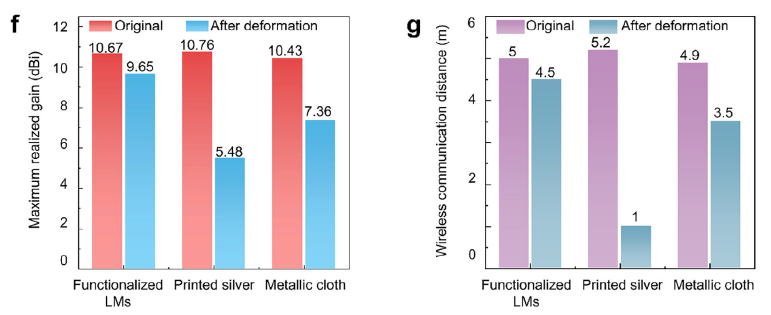
Figure 5 – Comparison of maximum achieved gain and wireless communication distance for liquid‑metal textile vs. commercial silver‑ink antenna in initial and deformed states
Leveraging its 4×4 high‑channel density and flexible synchronization architecture, the LW‑N310 served as the core platform for the entire mmWave communication system, handling the full‑chain task of BPSK signal generation, transmission, and reception/demodulation. It provided the team with complete experimental verification capability, faithfully reproducing real‑world body‑area communication scenarios.
Why Choose LW‑N310?
The LW‑N310 features a multi‑channel configuration designed for large‑scale, distributed wireless systems:
Wide frequency coverage: 10 MHz – 6 GHz, with 100 MHz instantaneous bandwidth per channel, covering baseband and IF signal processing; in this experiment, paired with an mmWave frequency converter module to extend to 26 GHz base station applications.
4×4 high‑density channels: Supports flexible synchronization, ideal for high‑channel‑count MIMO experiments.
High‑performance baseband processing: Powered by Xilinx Zynq‑7100 SoC (FPGA + dual‑core ARM), offering real‑time low‑latency processing.
High‑speed data interfaces: Dual SFP+ ports supporting 1/10 GbE for high‑throughput IQ data streaming.
Rich development ecosystem: Compatible with UHD API, RFNoC, GNU Radio, MATLAB, etc., enabling rapid prototyping.
Remote management: Supports remote debugging, updates, and monitoring, simplifying distributed experiment management.
From 2025 to 2026: Sustained Trust, Sustained Validation
This is not the first time Professor Lu Weibing’s team has chosen Luoguang ’ SDR platform for research validation. As early as 2025, the team used the LW‑N310 for wireless communication quality verification in their study on deformation‑resistant textile‑based FBSA (frequency‑scanning antenna), with results published in Science China Information Sciences. From 2025 to 2026, from Sub‑6G to mmWave, from frequency‑scanning antennas to liquid‑metal textile antenna arrays, Luoguang’s SDR platform has consistently accompanied every technological breakthrough of Southeast University’s flexible RF team, witnessing the complete loop from theory to measured validation in flexible wearable wireless communications.
Luoguang is committed to providing stable, reliable underlying verification support, partnering with research teams to advance cutting‑edge technologies from the lab into new stages of application innovation.