LW-X410 RFSoC SDR & GNU Radio DVB-S2 Satellite Communication Simulation System
As high-throughput satellites, remote sensing communications, and satellite broadcasting technologies develop rapidly, universities and research institutes urgently need an implementable, easily reproducible, and low-cost satellite communication link simulation and verification platform. Based on the self-developed LW-X410 high-performance software-defined radio (SDR) platform, equipped with a high-performance computing PC and the GNU Radio open-source waveform framework, LUOWAVE has launched a complete DVB-S2 communication simulation system. It fully replicates the full physical layer processing workflow from the satellite transmitter to the ground receiver, balancing the dual needs of communication protocol verification, modulation and coding algorithm testing, and classroom practical teaching.
Overall Hardware Architecture
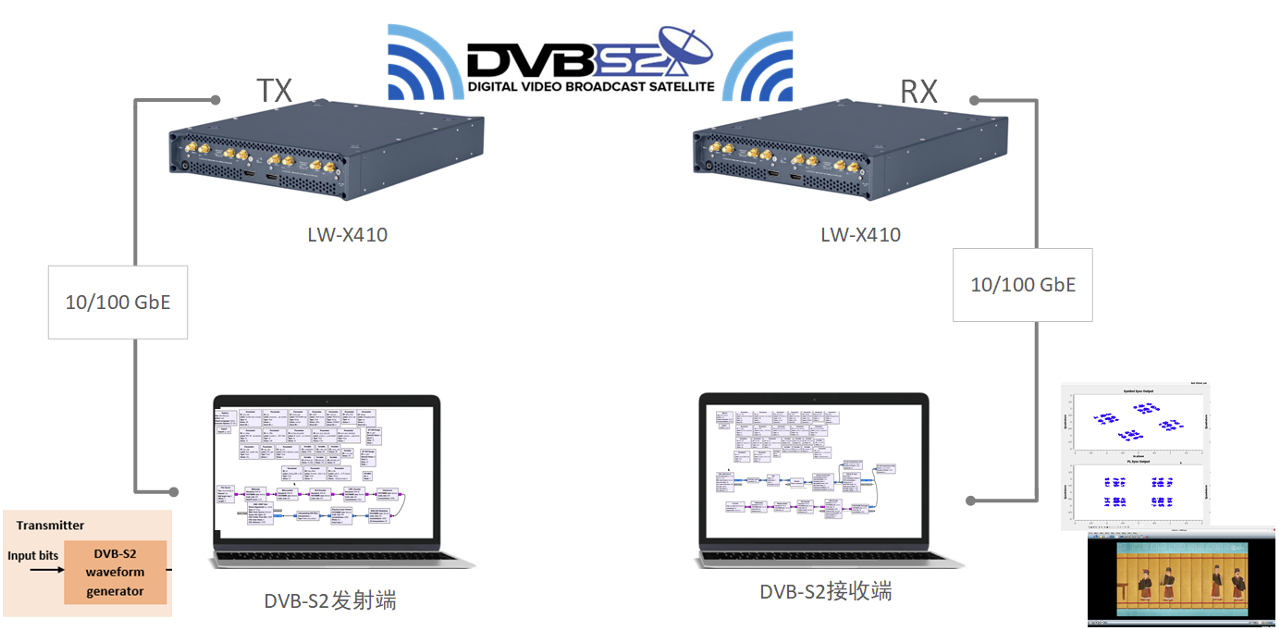
The system adopts an independent transmitter/receiver dual-unit architecture. Each unit consists of one LW-X410 high-performance SDR platform paired with one high-performance computing PC, simulating the signal transmitting unit and signal receiving unit respectively. It supports two transmission test modes: wired RF closed-loop and wireless over-the-air (OTA) radiation.
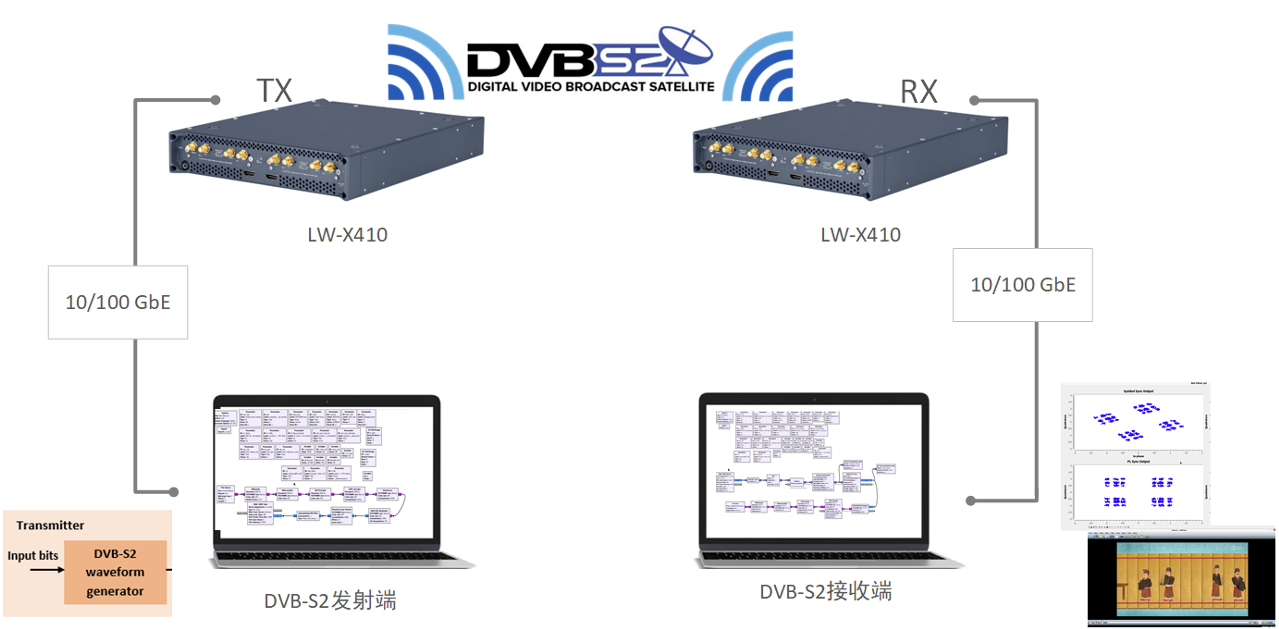
System Architecture Diagram
The complete hardware includes three core components:
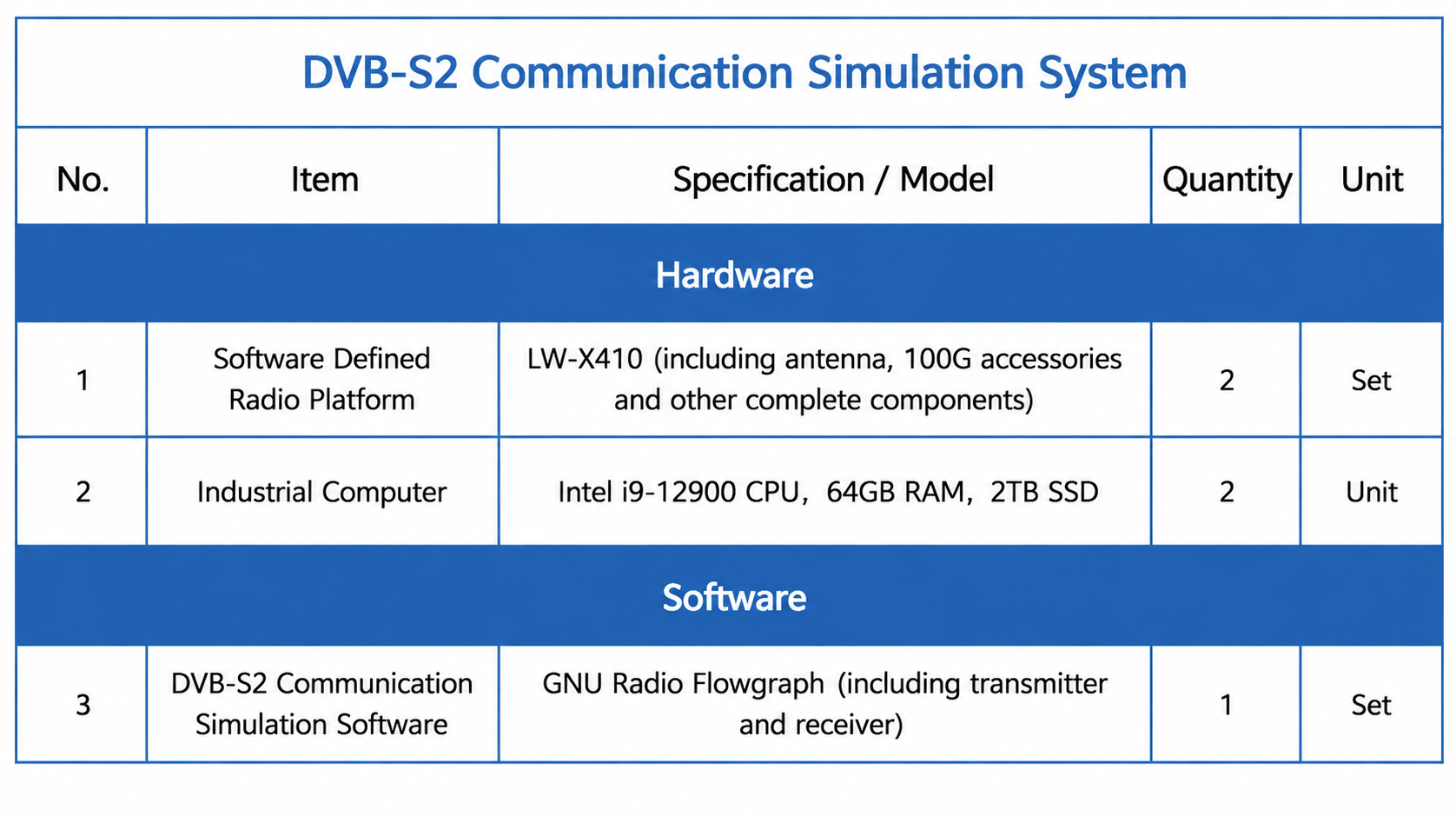
RF Hardware: 2 sets of LW-X410 SDR platforms equipped with dedicated transceiver antennas, responsible for RF signal modulation/transmission and RF reception/downconversion. As a domestic high-performance RFSoC (Radio Frequency System-on-Chip, an architecture tightly integrating RF and digital processing) SDR, the device covers mainstream satellite communication frequency bands with a wide bandwidth. Its large instantaneous bandwidth perfectly supports DVB-S2 standard symbol rate transmission, and its 4-transmit-4-receive hardware channels can adapt to subsequent higher-order communication waveform development, giving the platform long-term iterative expansion capabilities. Both LW-X410 units are equipped with 10/100GbE high-speed Ethernet interfaces, realizing high-speed baseband data transmission between the SDR and the host PC using a 100G interconnect kit.
Computing Host PC: 2 desktop PCs equipped with an Intel i9-12900 processor, 64GB of large-capacity memory, and a 2TB high-speed SSD, dedicated to running the GNU Radio waveform engineering and undertaking core computing tasks such as baseband coding/decoding, signal visualization, and experimental data storage.
64GB ultra-large memory: Can concurrently support LDPC iterative decoding and multi-window real-time rendering of spectra/constellations, ensuring long-term simulation without stuttering or dropped frames.
2TB high-speed SSD: Used to store massive test data sources, high-definition video TS streams, long-term test waveforms, and experimental logs, meeting the reproduction requirements of large-batch experimental data.
Multi-core high-performance processor: Significantly shortens the computation time of BCH+LDPC cascaded coding and synchronization algorithms, stably supporting real-time transmission of high-speed data streams.
Matching Simulation Software: 1 complete GNU Radio DVB-S2 waveform project, containing independent transmitter and receiver visualization flowgraphs, ready for out-of-the-box full-link simulation and debugging.
System Overall Connection Method
The system supports two test links: wired closed-loop test mode where the transmitter and receiver SDRs are directly connected via RF cables, and wireless OTA transmission mode where both ends are connected to external antennas.
RF Connection: Each LW-X410 features 4 transmit and 4 independent receive RF channels. In wireless OTA mode, each channel is connected to an external antenna; in wired closed-loop testing, the RF channels of the transmitting and receiving SDRs are directly connected via RF cables.
Data Connection: Each SDR device connects to its corresponding host PC via a 10/100G QSFP28 high-speed optical port and a matching 100G interconnect kit, transmitting baseband data to complete data interaction and real-time processing. At the software level, the DVB-S2 communication simulation software based on GNU Radio is deployed on the Ubuntu system.
Software Modular Processing Workflow
Transmitter Complete Signal Processing Link
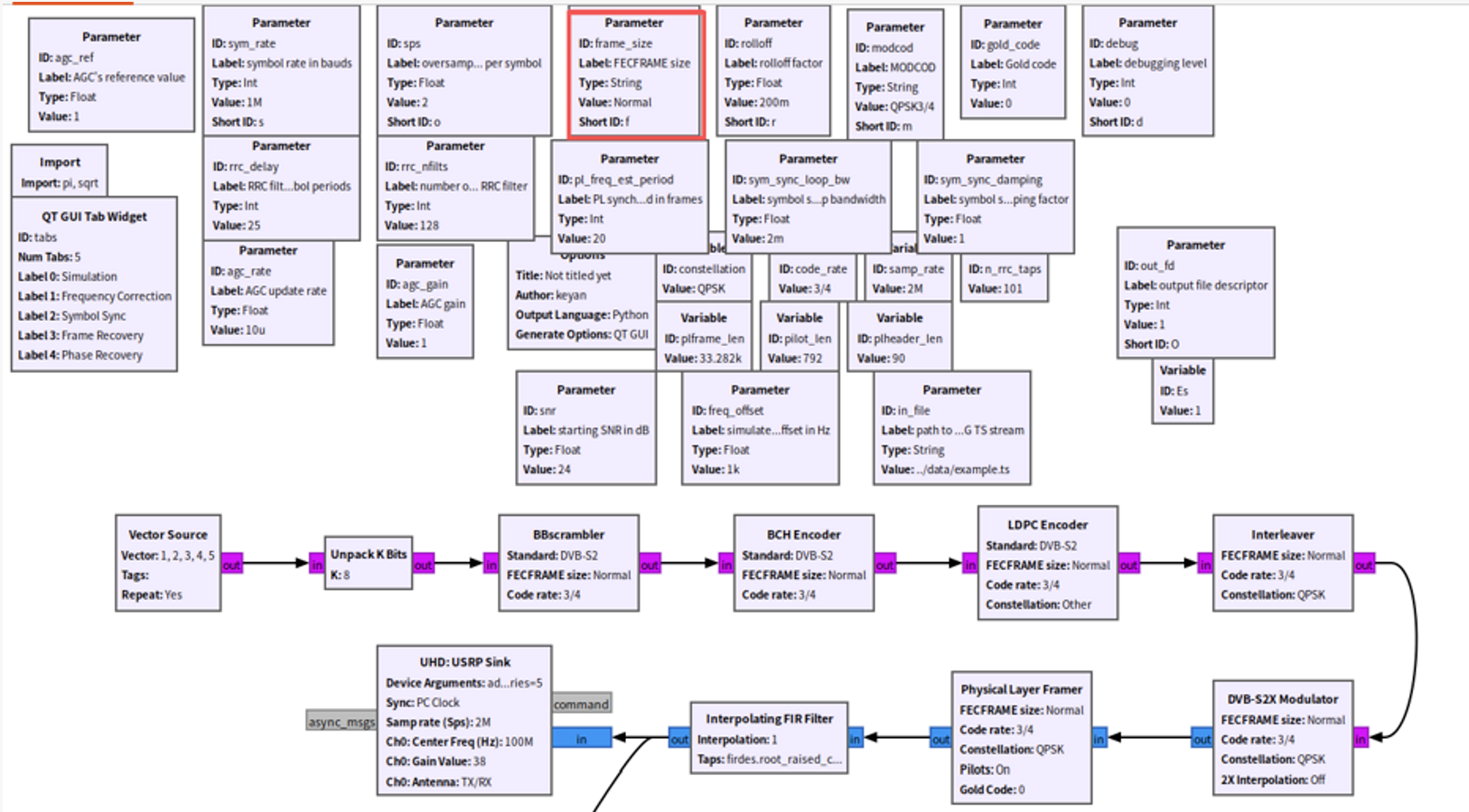
The transmitting flowgraph processes input data (text files or video TS streams) sequentially through mode adaptation and stream adaptation scrambling, BCH coding, LDPC coding, bit interleaving, constellation mapping, PLFRAME framing (including frame headers and optional pilots), and baseband shaping filtering, before transmitting via RF through the SMA interface.
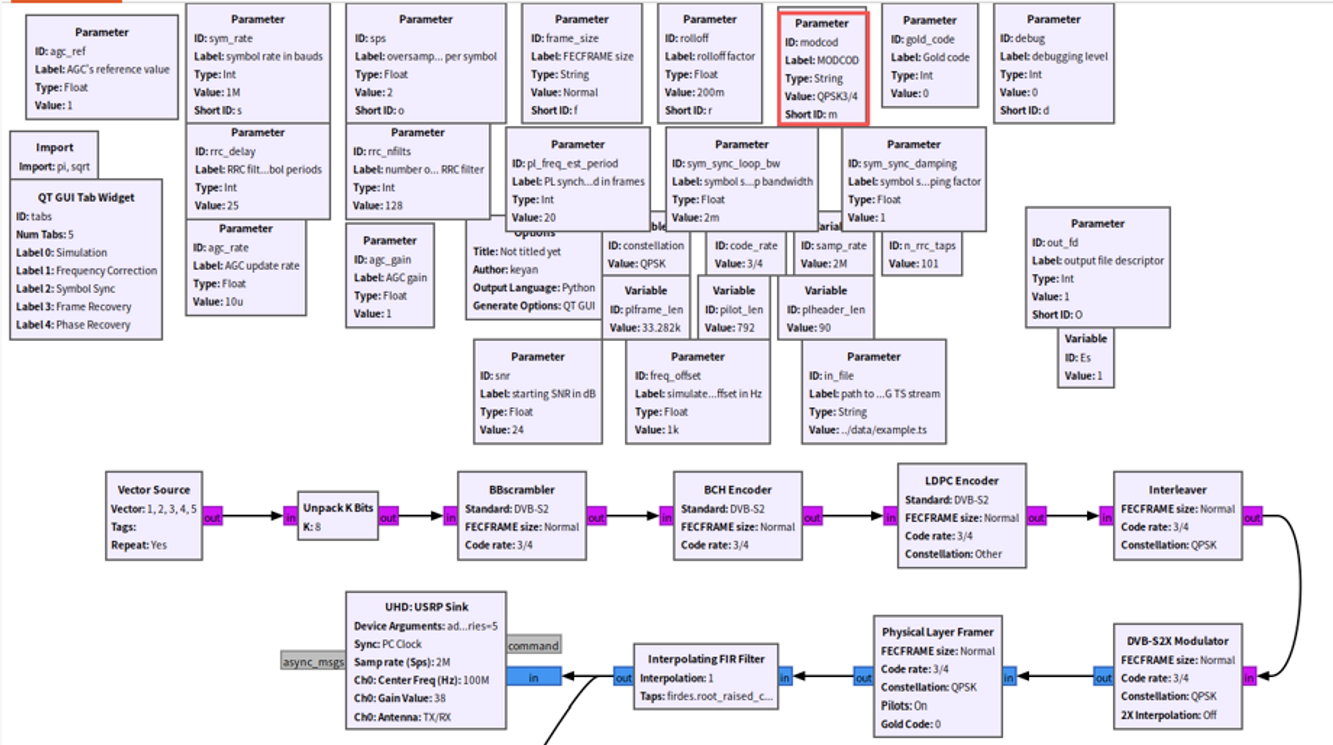
Transmitter Flow Diagram
Receiver Complete Signal Processing Link
The receiving flowgraph receives RF signals through the SMA interface, sequentially completing downconversion, frame synchronization acquisition, carrier synchronization, timing synchronization, PLFRAME deframing, constellation soft demodulation, bit deinterleaving, LDPC decoding, BCH decoding, descrambling, and data restoration to output text or video files.
Receiver Flow Diagram
Visual Monitoring Capability
The flowgraphs feature built-in QT GUI components, outputting real-time constellation diagrams, time-domain waveforms, and spectral waterfall displays during operation, allowing direct observation of link signal-to-noise ratio, synchronization status, and signal distortion to quantitatively evaluate space-ground transmission link quality.
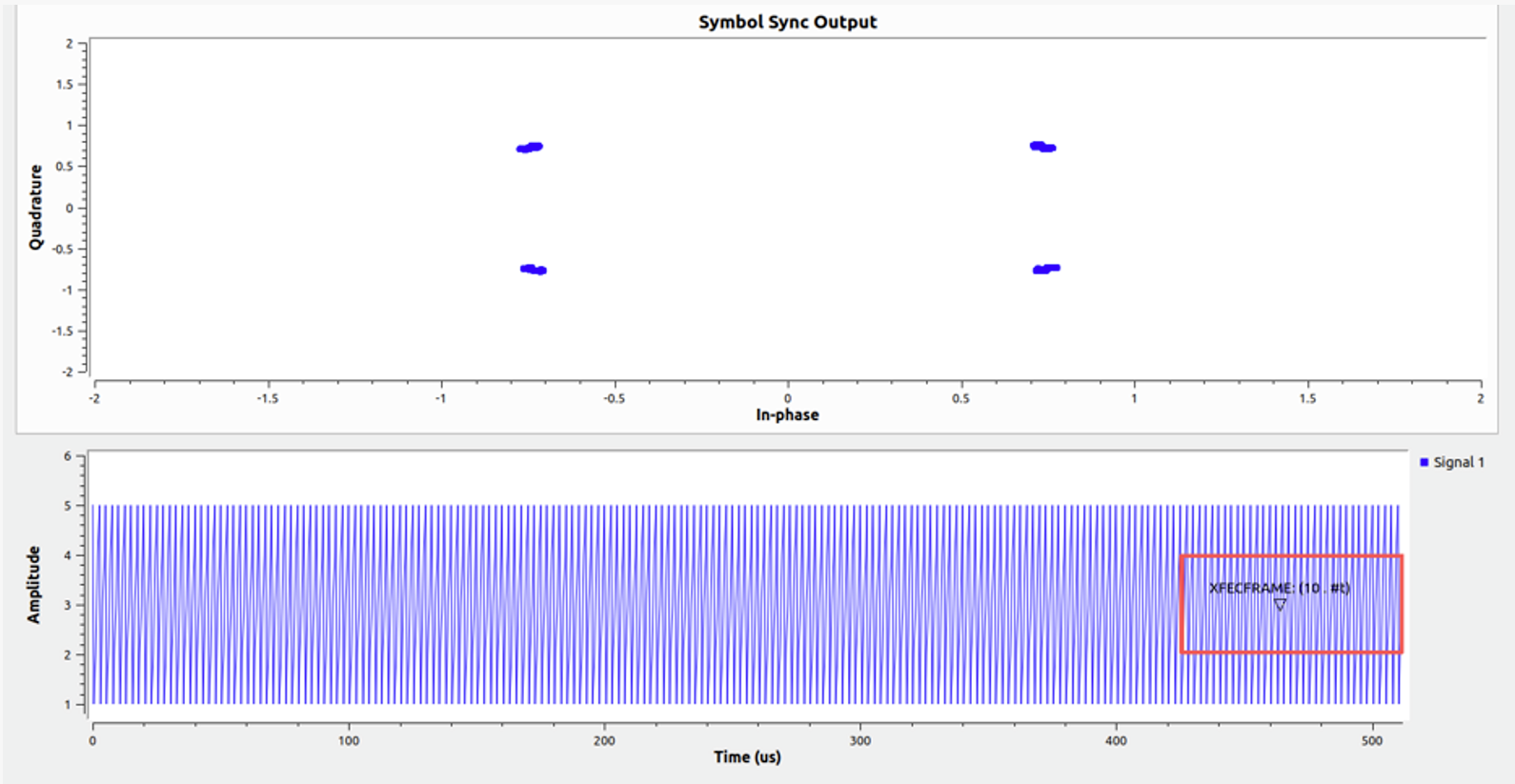
Test Results of DVB‑S2 QPSK Demodulation Symbol Synchronization Constellation and Time-Domain Frame Waveform
System Core Capability Indicators
Communication protocol standard: DVB-S2 (ETSI EN 302 307-1).
Supports multiple modulation schemes such as QPSK, 8PSK, 16APSK, and 32APSK.
Supports multiple code rates.
Supports normal frame and short frame structures.
Employs a cascaded coding method combining BCH outer codes and LDPC inner codes.
Supports two business types: text transmission and unidirectional video stream transmission.
Supports DVB digital signal transmission via both wired and wireless methods.
Three Core Application Scenarios
University Communication Professional Teaching & Training: Graphical GNU Radio flowgraphs completely display the full-process physical layer logic of DVB-S2, visually presenting coding, modulation, synchronization, and demodulation across the entire link. This significantly lowers the learning threshold for abstract satellite communication theories and suits experimental teaching for courses such as Communication Principles, Satellite Communications, and Software Defined Radio.
Communication Algorithm Scientific Research Verification Platform: Enables low-cost reproduction of wireless fading transmission channels in a laboratory environment without relying on real satellite resources, allowing rapid iteration of self-developed algorithms like LDPC decoding, carrier synchronization, frame synchronization, and channel equalization, effectively shortening project R&D and verification cycles.
Communication Scheme Preliminary Performance Preview: Enables closed-loop testing of DVB-S2 communication links prior to online deployment, allowing advance verification of modulation/coding schemes, symbol rates, and frame structure adaptation performance, preemptively identifying link transmission defects to reduce communication project test costs and trial-and-error risks.
Configuration List
Conclusion
This DVB-S2 communication simulation system adopts a hardware-software integrated solution, combining the LW-X410 RF hardware with a complete GNU Radio waveform project, allowing users to build a complete communication simulation link right out of the box. Equipped with a high-computing host PC, the complete scheme stably supports long-term, high-traffic high-speed simulation testing. The platform boasts strong expandability with sufficient hardware bandwidth and channel resources to accommodate subsequent development of various new communication waveforms. At the same time, the system is equipped with real-time visual monitoring tools, outputting constellations, spectra, and time-domain waveforms synchronously to intuitively and quantitatively assess link transmission performance.