
5G Indoor Positioning & Wireless Sensing Validation System | Based on LW-B210 SDR
High‑precision indoor positioning is a core research direction in 5G wireless sensing and next‑generation communication networks. To address the experimental needs of university research groups and scientific institutions—including positioning algorithm validation, wireless channel modeling, and multi‑domain channel observation—LUOWAVE introduces a complete three‑node cooperative 5G indoor positioning verification system based on the LW‑B210 software‑defined radio platform.
System Overview
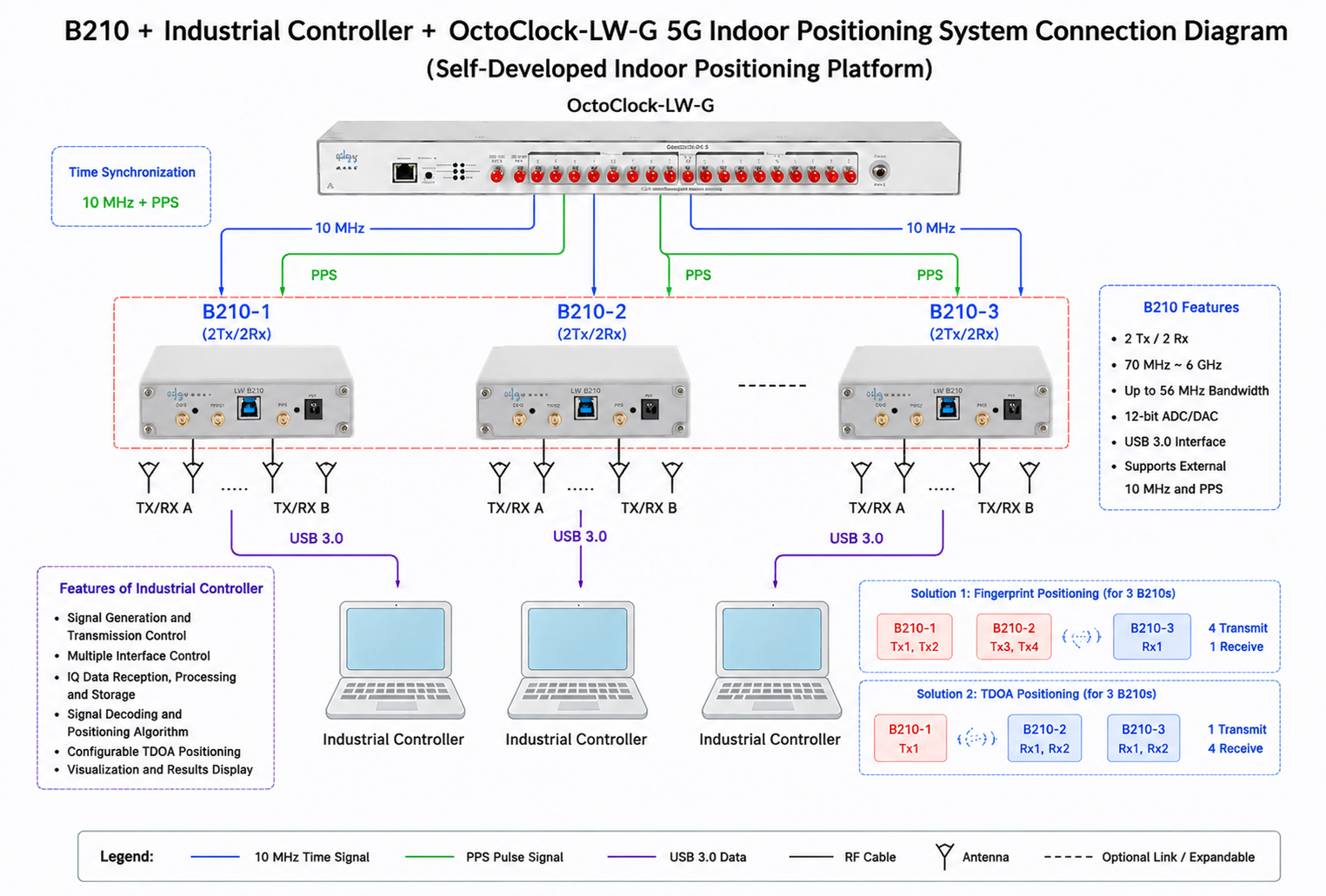
The 5G indoor positioning system is constructed on the LW‑B210 SDR platform, employing a self‑transmitting and self‑receiving closed‑loop architecture.
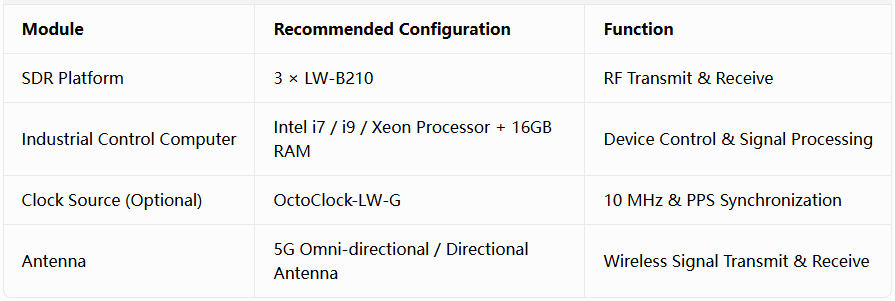
It comprises three LW‑B210 RF transceiver nodes, industrial PCs (or laptops), an OctoClock‑LW‑G clock source, and matching antennas.
The system optionally integrates a clock source that distributes a 10 MHz frequency reference and PPS time synchronization signals to all three LW‑B210 units, enabling high‑precision multi‑node synchronization. Each LW‑B210 connects independently to a host PC via USB 3.0. The multi‑PC coordination handles 5G NR‑like positioning reference signals / custom wideband OFDM signal generation, synchronous TX/RX control, real‑time IQ data capture and analysis, TDOA/fingerprint positioning algorithm validation, trajectory display, and experimental data storage.
The LW‑B210 features 2Tx/2Rx, 70 MHz–6 GHz frequency coverage, up to ~56 MHz real‑time bandwidth per channel, and external 10 MHz / PPS synchronization interfaces—making it ideal for small‑scale 5G indoor positioning prototyping and research. The platform reliably outputs key observables including CSI, RSSI, and TOA/TDOA, supporting positioning algorithm development and performance verification with excellent scalability and re‑development capabilities.
Hardware Components
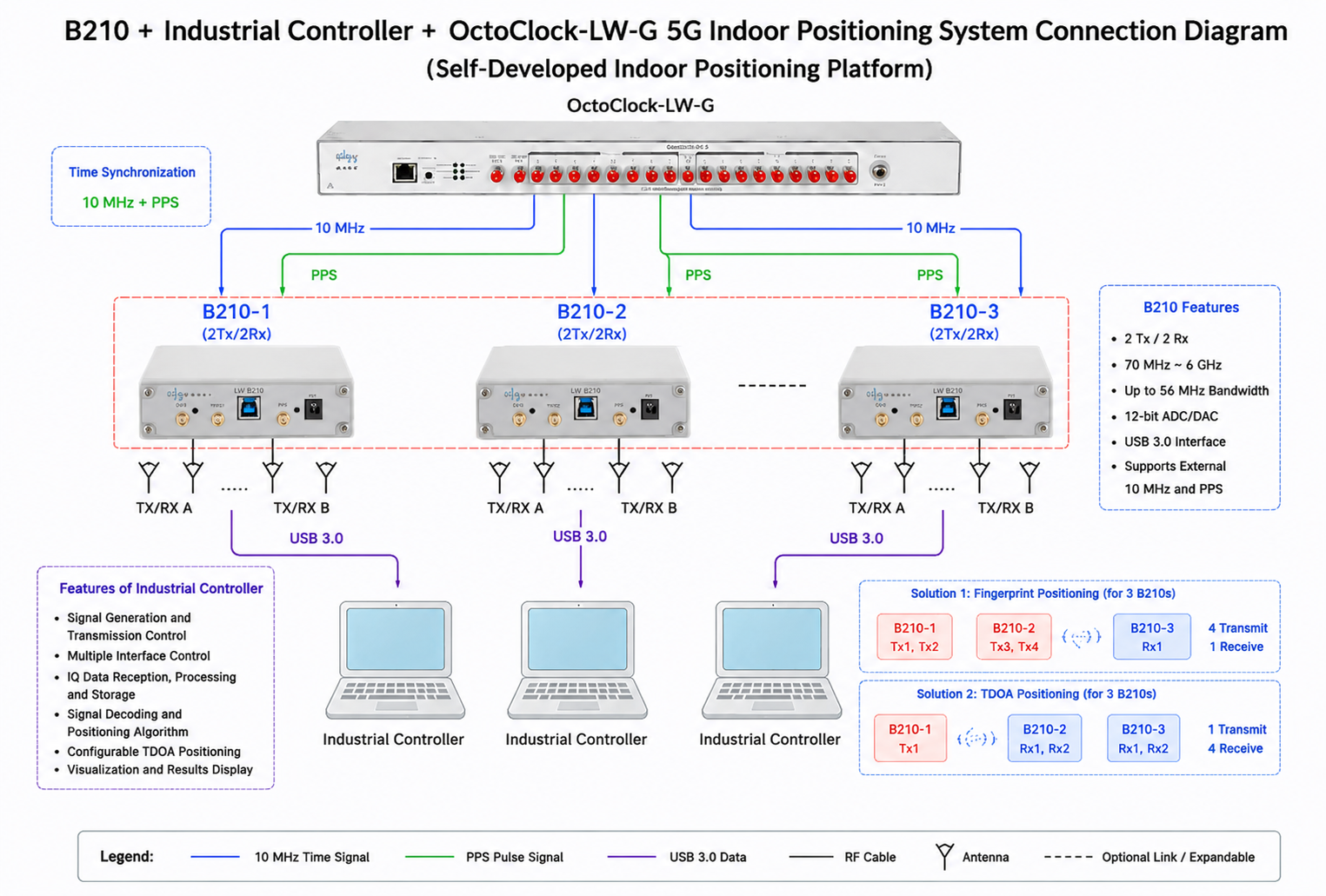
System Connection Topology
(1) CLK and PPS Trigger Connections
The OctoClock‑LW‑G clock source (optional) provides 8 channels of 10 MHz clock and 8 channels of PPS synchronization signals. For TOA/TDOA positioning requiring strict synchronization, this module is recommended. Connect the 10 MHz output to the LW‑B210 REF IN port, and the PPS OUT to the LW‑B210 PPS IN port to achieve high‑precision multi‑device time synchronization.
(2) RF Connections
Each LW‑B210 supports two receive channels and two transmit channels. Each RF channel connects to its antenna via RF cables.
(3) Data Connections
Each SDR device transfers baseband data to its corresponding host PC via USB 3.0, enabling data exchange and real‑time processing.
Software Architecture
The system software adopts a layered modular architecture, with hardware control implemented via the UHD driver. It consists of the following seven layers:
1. UHD Device Control Layer
2. 5G NR Signal Generation Layer
3. Synchronization Control Layer
4. IQ Data Acquisition Layer
5. Real‑time Spectrum & Correlation Peak Display Layer
6. Channel Feature Extraction Layer
7. Positioning Algorithm Layer
Positioning Modes
Mode 1: Fingerprint Positioning
In fingerprint mode, two B210 units serve as transmitting nodes, and one B210 serves as the receiving node.
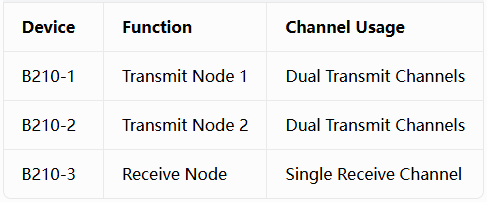
Recommended positioning features include (but are not limited to):
- RSSI / RSRP
- CSI amplitude and phase
- SNR
Mode 2: TDOA Positioning
In TDOA mode, one B210 acts as the transmitting node, and the other two B210 units act as synchronized receiving nodes.
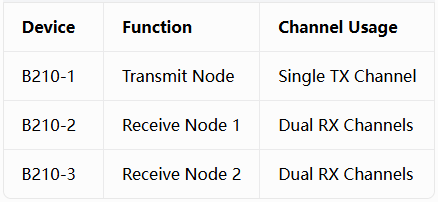
The system estimates time of arrival via correlation peak detection and then calculates the time difference of arrival between receiving nodes.
TDOA Core Relationships:
Time Difference of Arrival: 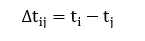
Corresponding Distance Difference: 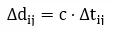
where speed of light :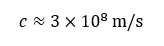
Specifications
The system leverages the LW‑B210 SDR for 5G signal transmission and reception. Key specifications:
(1) Coverage: 20 m × 20 m
- Static positioning accuracy: < 2 m (67% probability) with single base station
- Supports both single‑base‑station and multi‑base‑station positioning methods
- Supports machine learning‑based positioning algorithms
(2)Provides secondary development interfaces
- Supports indoor positioning and sensing algorithm development based on 5G CSI and RSSI
(3) Outputs observables including CSI, RSSI , and TOA/TDOA
System Features & Application Areas
- Fingerprint positioning & TDOA positioning
- Multi‑device synchronized acquisition
- Real‑time IQ data recording
- Channel feature analysis (CSI, etc.)
- Suitable for 5G indoor positioning research validation
- Scalable to additional SDR nodes
Application Directions:
5G indoor positioning, wireless channel modeling, CSI sensing, trajectory tracking, high‑precision synchronized acquisition, and AI‑based positioning algorithm validation.
Conclusion
This LW‑B210 based 5G indoor TDOA/fingerprint positioning verification system, powered by the OctoClock‑LW‑G nanosecond‑level synchronization clock, achieves < 2 m static positioning accuracy and fully covers experimental requirements for both mainstream indoor positioning algorithms. With fully open raw IQ data at the baseband and software support for secondary development, the platform is well‑suited for teaching labs, algorithm iteration, and channel modeling research—delivering a lightweight, cost‑effective solution for scientific experimentation.
For detailed technical specifications or a demonstration proposal, please contact the Luoguang Electronics technical team.
---
Let me know if you need any adjustments—terminology preferences, shortened abstracts, or additional formatting for web publication.