
Metasurface TEMPEST Defense with LW‑N210 – NUS Research Validated
Recently, a research team from the Department of Electrical and Computer Engineering at the National University of Singapore (NUS) made significant progress at the intersection of information security and metamaterials. Their paper, "A Metasurface-Enabled TEMPEST Countermeasure Based on Amplitude and Phase Joint Modulation," was presented at the 2026 Asia‑Pacific International Symposium on Electromagnetic Compatibility (APEMC) and officially published on IEEE Xplore on July 10, 2026. The work proposes a novel TEMPEST defense strategy based on metasurface amplitude‑phase joint modulation, which applies irreversible distortion to leakage signals to effectively counter AI‑assisted information reconstruction attacks targeting digital interfaces.
TEMPEST refers to a class of attack and defense techniques that reconstruct sensitive information (e.g., screen content) "over the air" by intercepting unintentional electromagnetic emissions from devices.
Addressing AI‑Based Reconstruction – Electromagnetic Defense Enters the Metasurface Era
As modern AI‑assisted reconstruction techniques evolve, traditional electromagnetic shielding methods face severe challenges in defending against deep learning‑driven image recovery attacks. The NUS research team proposed and experimentally validated a metasurface‑based amplitude‑phase joint modulation scheme to address this challenge.
Core Concept: Dynamic dual‑domain interference on both amplitude and phase, overcoming the limitations of single‑domain modulation.
Experimental Validation: Amplitude‑only distortion can be partially corrected by AI; however, with phase perturbation added, the leaked information becomes irreversibly distorted, physically blocking the reconstruction path.
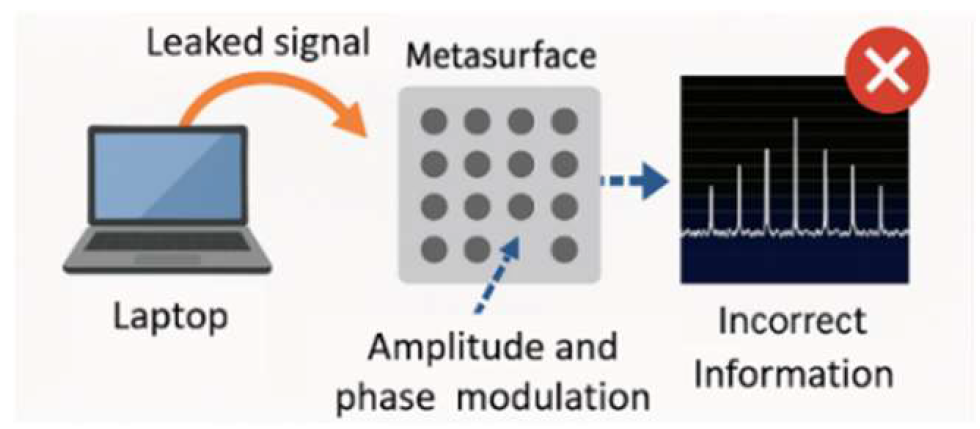
Figure 1 – Schematic of metasurface amplitude‑phase joint modulation principle
Caption: The metasurface dynamically modulates amplitude and phase to tamper with electromagnetic leakage signals, causing eavesdroppers to acquire corrupted information, thereby achieving physical‑layer protection.
LUOWAVE LW‑N210 – A Critical Component for Weak Leakage Signal Acquisition
A core challenge in TEMPEST experiments is capturing weak electromagnetic leakage signals with ultra‑low signal‑to‑noise ratio (SNR) that are highly susceptible to interference. In this study, the LUOWAVE LW‑N210 served as the core acquisition device, undertaking the critical data capture task.
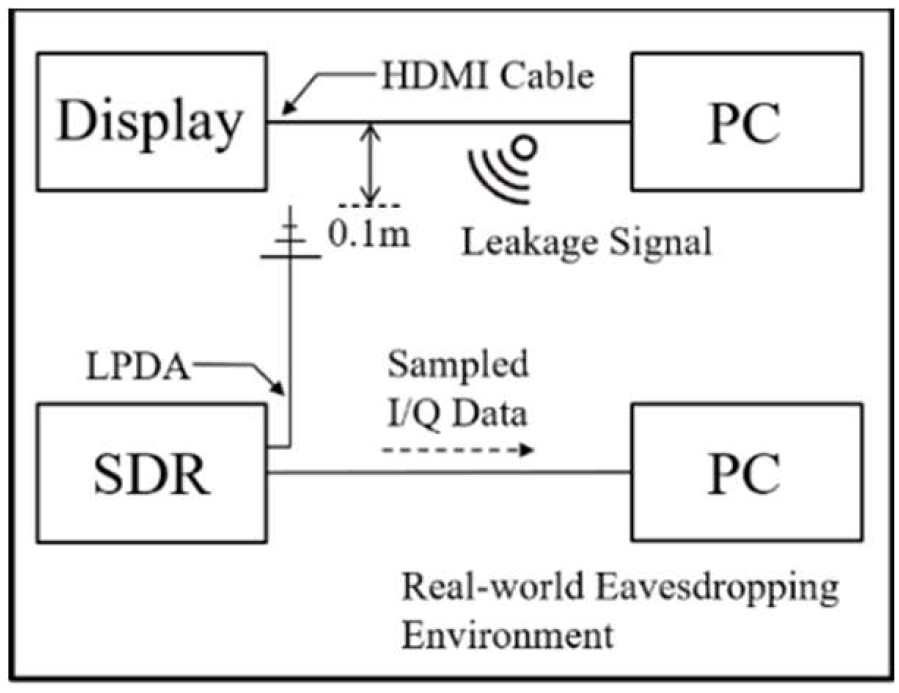
Figure 2 – Experimental setup
Caption: The experiment used an LG 43QNED82ATA monitor (1920×1080 resolution) as the test target. The acquisition chain comprised a PC, display terminal, HDMI cable, HT8 log‑periodic dipole antenna (LPDA), and LW‑N210.
The researchers placed the antenna just 0.1 meter from the HDMI cable for signal capture. The N210 operated at a center frequency of 742.5 MHz with a 60 MHz sampling rate, preserving high‑fidelity raw I/Q data. Its high sensitivity and high dynamic range effectively filtered out background noise in a typical indoor environment, precisely extracting weak leakage signals and providing reliable ground‑truth data for the research.
Experimental Validation – Amplitude‑Phase Joint Modulation Achieves Information Obfuscation and Reconstruction Suppression
Leveraging real‑world data acquired by the LW‑N210, the team thoroughly validated image reconstruction performance under different modulation strategies. The experimental results are striking:
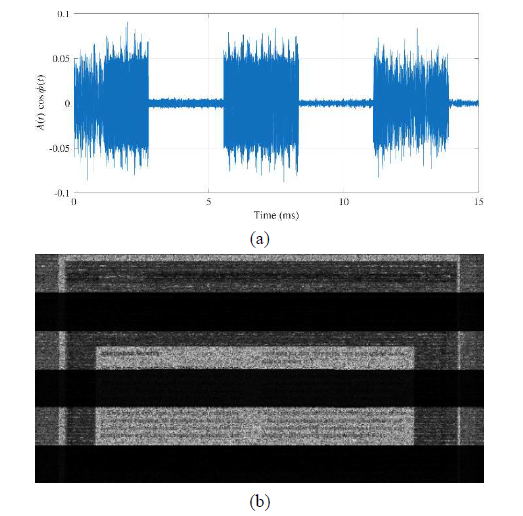
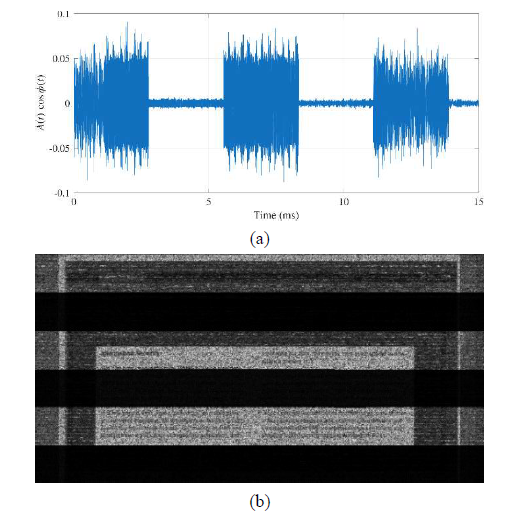
Figure 3 – Comparison of amplitude‑phase joint modulation effectiveness
Caption: (a) Time‑domain waveform of the original leakage signal; (b) After amplitude‑phase joint modulation, the reconstructed image at the attacker's side becomes completely noisy, with original information totally unrecognizable.
The experiments confirm that amplitude‑phase joint modulation corrupts signal features from both amplitude and phase dimensions, completely suppressing AI‑based image reconstruction. The protection effectiveness is significantly superior to conventional approaches, offering a highly efficient new solution for physical‑layer electromagnetic security.
Conclusion – Advancing SDR Technology to Support Global Cutting‑Edge Research
From communication protocol validation to physical‑layer security defense, Software Defined Radio (SDR) – with its inherent advantages of wide frequency coverage, high sampling rates, and programmable reconfigurability – has become an indispensable core platform for electromagnetic signal acquisition and modulation verification.
LUOWAVE continues to advance high‑performance SDR technology, providing stable and reliable hardware support for global research teams. This LW‑N210‑assisted NUS breakthrough in TEMPEST defense fully validates the product's adaptability and technical capability in frontier physical‑security scenarios. Going forward, LUOWAVE remains committed to empowering high‑level research innovation with robust hardware, helping push the boundaries of radio technology ever further.