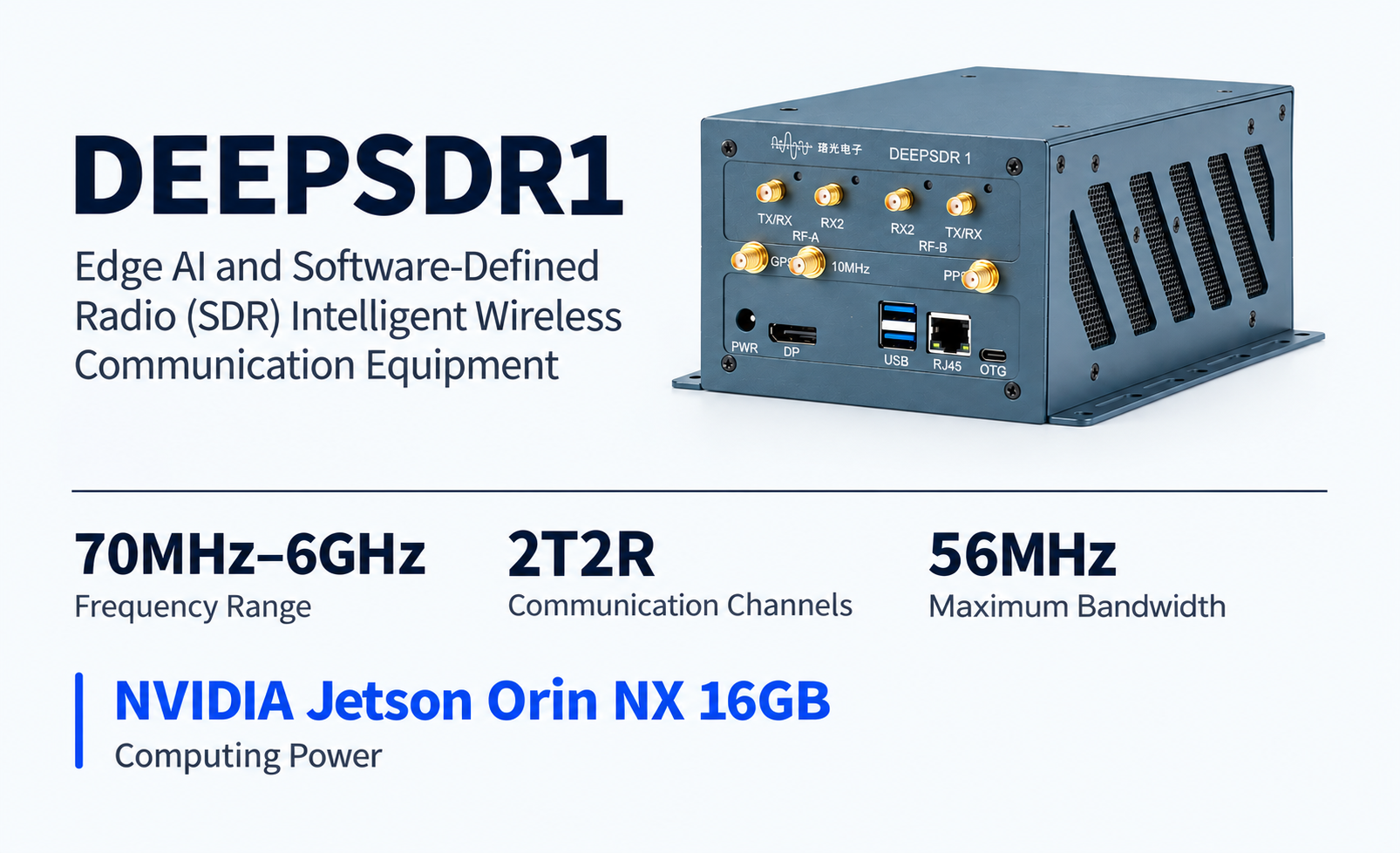
Combining AI computing power with an RF front end is a key step in moving software-defined radio (SDR) from algorithm validation to practical applications. Luowave's DEEPSDR 1 integrates an NVIDIA Jetson Orin NX with an onboard RF unit, enabling signal acquisition and edge AI inference on a single device.
Our engineering team has recently upgraded the demo suite using real hardware. This article introduces two applications, with demonstration videos showing their practical performance.
Application 1. Drone Video Transmission Signal Recognition (DJI Real-World Test — Upgraded Edition)
Algorithm Architecture
This application uses a two-stage recognition pipeline. YOLO detects candidate signals in time-frequency representations, while ResNet extracts features and classifies them. Models are exported to ONNX and optimized with TensorRT. GPU shared-memory zero-copy transfer reduces data-transfer overhead between the RF unit and the neural network.
Real-World Testing Verification
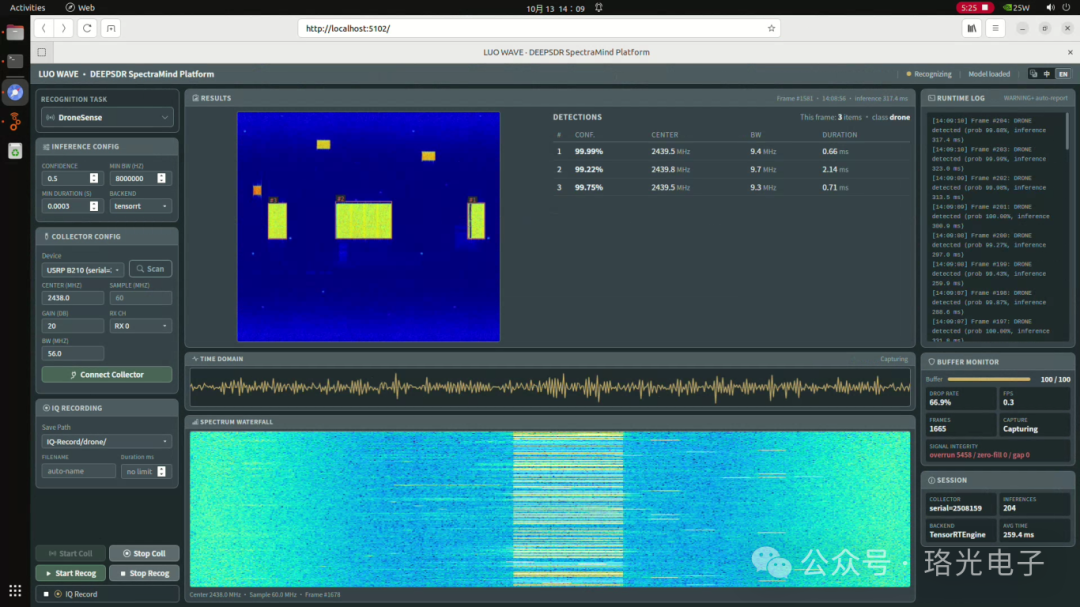
Tested with DJI drones in a real-world environment, DEEPSDR 1 captures over-the-air signals through its onboard RF unit and feeds them into the recognition model. The web interface displays the spectrum waterfall, YOLO detection boxes, classification results, and confidence scores.
The application supports real-time acquisition and offline playback, with configurable parameters, data storage, and searchable logs.
Application 2. AMR-Benchmark Modulation Scheme Recognition
Algorithm Architecture
Based on the open-source AMR-Benchmark project, this application demonstrates real-time recognition across 24 signal modulation formats.
Real-World Testing
A separate LW-B210 transmits signals that DEEPSDR 1 receives and classifies in real time. The demo covers BPSK, QPSK, and AM modulation.
Results are categorized using a configurable confidence threshold, such as 0.7. Green indicates high-confidence results, yellow indicates results requiring attention, and light gray indicates low-confidence results. Constellation diagrams are also displayed for signal analysis.
Key Features of DEEPSDR 1
Edge AI Computing
Powered by NVIDIA Jetson Orin NX, DEEPSDR 1 supports frameworks such as TensorFlow and PyTorch. CNN- and Transformer-based models can run directly on the device without relying on external computing resources.
Ready-to-Run Demos
One-click launch scripts integrate signal acquisition, model inference, and visualization into a single workflow, helping engineers validate algorithms more efficiently.
Development Compatibility
DEEPSDR 1 supports tools such as GNU Radio and MATLAB, helping developers integrate the platform into existing SDR workflows.
A Unified Software Platform
These two demos represent only part of DEEPSDR 1’s application capabilities. We are developing a unified software platform that will progressively integrate a broader range of AI application models. With one-click startup, users can access multiple applications in the same environment without separately configuring software environments, adapting drivers, or debugging code for each demo.
Beyond the two applications featured in this article, additional demos have been validated using real RF signal chains and are being progressively integrated into the unified platform.
Conclusion
DEEPSDR 1 brings edge AI and software-defined radio together in an intelligent wireless platform. We will continue expanding the demo suite and enhancing the unified software platform, allowing engineers to focus on algorithm development and application logic.
Interested in a Demo or Custom Development?
Contact us to learn more about technical documentation and evaluation units available for testing.